Linton Kirk Heritage Appeal
Kelso, United Kingdom
Aim
Please help us to raise £30,000 towards the purchase of Linton Kirk, one of the oldest and most beautiful churches in Scotland.
“The saving of rural churches is fundamental to also saving local communities and Linton Church is no different. It also has added historical significance and is a most beautiful piece of architecture.
It would be a real shame if Linton Kirk was not saved by, and for, the local community and I commend this fundraising effort to one and all irrespective of background.”
John Jeffrey, local farmer and former rugby player
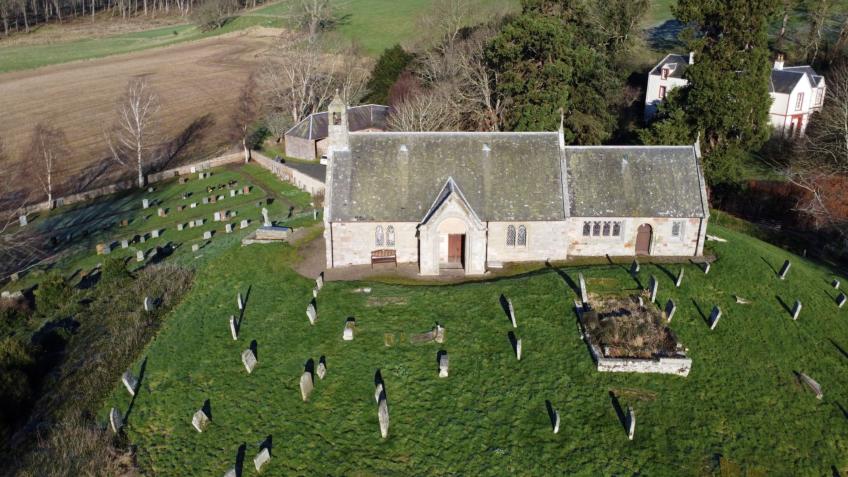
Throughout the country, Church of Scotland congregations are being united, linked or even dissolved, and a number of churches placed on a disposal list and earmarked for sale. This includes Linton Kirk in the Scottish Borders, one of the oldest and most beautiful churches in Scotland.
The Linton Kirk Heritage Appeal (LKHA) has the opportunity to buy Linton Kirk to secure its future as a place for peaceful prayer, and occasional worship, for visitors and the local community. Our Crowdfunder appeal aims raise £30,000 towards the purchase price.

900 Years of Worship
"In the solitude of this sacred place far from the stress and strains of modern day living, perhaps, a person can find themself ..." (Linton Kirk Visitor Book)
Described by many as a place of great beauty, peace and spirituality, in 2027, and with your help, Linton Kirk could celebrate 900 years of continuous worship since the first recorded use in 1127 A.D.
LKHA believes this is the ideal time to give the church its next best life by safeguarding its history and heritage for future generations.
The Parish of Linton
First mention of the barony of Linton appears in the 12th century, when one William de Somerville received from William the Lion the "lands of Lintun", reputedly as a reward for ridding the territory of "ae great Worme", an exploit commemorated by the carved tympanum (unique in Scotland) above the church door.
"Indescribable feeling to stand in this church and view lintel above the entrance. Somervilles may be far flung on this world but this is their spiritual home. It was always my father's wish to stand where I stand today." Linton Kirk Visitor Book (New Zealand)
Six miles long and two miles broad, the rural parish of Linton sits one mile north of the village of Morebattle, four miles from Yetholm, just under five miles from Hownam, and some seven miles from the market town of Kelso, ‘the most beautiful if not the most romantic village in Scotland’ according to Sir Walter Scott.
Hidden Gems
Described as having a "museum like quality", Linton Kirk is home to a number of rare artefacts of historical and cultural significance. Two of which, the Norman Font and the Tympanum above the porch door, are relics of the Pre-Reformation Church.
Embedded in the upper section of the small Nunc Dimittis window, the work of Mr Douglas Strachan, are several fragments of ancient glass found in Holyrood Palace, Edinburgh, during excavations made in 1910-1911. This glass is thought to date from the late thirteenth or fourteenth century, and through it the light must often have fallen on Mary Queen of Scots, and many other Scottish sovereigns, as they knelt in prayer in the Chapel Royal. Douglas Strachan is considered the most significant Scottish designer of stained glass windows in the 20th century.
Storytelling
As well as objects of historical and cultural significance, a number of intriguing legends are attached to Linton Kirk, including how the church came to be built.
According to the legend of the ‘ladies doomed by Rome’s command, to shift the churchyard mound of sand’, a young man killed a priest and was condemned to die for the crime. Strong intercessions, however, were made on his behalf and it was agreed that if his two sisters would undertake the penance of sifting as much sand as would form the mound upon which Linton Church was to be built, his life might be saved. Through patient toil, the task was completed, though at the sacrifice of one of their lives. The youth was saved and the stoneless heap remains a clear testimony to many of the truth of the legend, while a hollow, a short distance to the westward, marks the spot from which the materials were taken.
The area remains steeped in folklore, a reminder of the enduring power of myth and storytelling in shaping regional identity.
Family History
‘Visiting the final resting place of a father-in-law I never had the privilege of knowing.’ Linton Kirk Visitor Book (USA)
Surrounding the church, the graveyard is said to contain the earliest known possessors of the lands of Linton, the earlier Somervilles and the Graden Kers. Several of the stones are of interest for their carvings as well as for the information they give about the people of the neighbourhood over the centuries.
Family inscriptions include: Anderson, Bell, Darling, Davidson, Douglas, Elliot, Galbraith, Graham, Hall, Hamilton, Henderson, Murray, Oliver, Pringle, Purves, Robson, Rutherford, Scott, Smith, Somerville (and variations), Taylor, Telfer, Trotter, Turnbull, Walker and Young.
Linton Kirk Heritage Appeal
LKHA is a Registered Charity (SC007952), set up in September 1984 to preserve Linton Kirk for the advancement of religion, the arts, heritage and culture.
www.lintonkirk.org
This project successfully funded on 20th April 2026